
by IPPOG Communication
Highlights from the 30th IPPOG Meeting at CERN
The 30th IPPOG Collaboration Meeting took place at CERN from 27 to 30 October 2025, bringing together members, coordinators, and guests from across the globe to share best practices, success stories, and future directions for particle physics outreach and education.
Day 1 – Inspiring Success Stories
The meeting opened with a dynamic series of presentations highlighting innovative outreach initiatives worldwide. Among the featured contributions:
Takano Wakiko: SORAMAME: Scientific Observation & Research on Astroparticles—Anywhere, by Anyone
Viktoria Bacso: Crafting Curiosity: From Classrooms to CERN
Steven Goldfarb: Early Morning Coffee at CERN
Viviana Scherini: Auger Open Data and Outreach Portal
Thierry Masson: Physics on the Infinity Canvas, A new tool for popularization and pedagogy
Claire Adam Bourdarios: Success Stories on the new IPPOG Portal
Venus Keus: SIMpossible
Christian Klein-Bösing: Human heavy ion collision at a music festival
Prof. Kevin Mosedale: High School Particle Physics in the UK – A Teacher’s Perspective
Camilla Maiani: Wonders of the Curie Museum (Paris)
Fabiola Cacciatore: Masterclass for Non-Scientific CERN Personnel
Verania Navarro and Yiota Foke: Engaging Students and Their Community in Physics Education – A Mexican Case Study
Alicia Mand: The Distributed Electronic Cosmic-ray Observatory (DECO)
Day 2: Steerings Groups
During the afternoon, the Steering Groups (Global Cosmic, IMC, and Resources Portal) held their meetings, followed by an aperitif to celebrate the handover of the IPPOG Chairs. Starting in January 2026, Pedro Abreu and Claire Adam will step down as Chairs, passing the torch to Anja Kranjc Horvat (current Slovenia Representative) and Steven Goldfarb (current ATLAS Experiment Representative), who will serve as IPPOG Co-Chairs for the next three years.
Day 3 – Collaboration activities
The following day featured review talks by experiments and countries that either member of closely related to IPPOG activities.
It started with a session on outreach of Applications for Society, and a tribute to Hans Specht.
In the neutrino session two new experiments were presented : KM3Net (Marco Circella) and Dune (Kate Shaw).
The activities in Brazil (Marcelo Munoz) Croatia (Vuko Brigljevic) and the CMS experiment (Sofia Hurst) where then discussed.
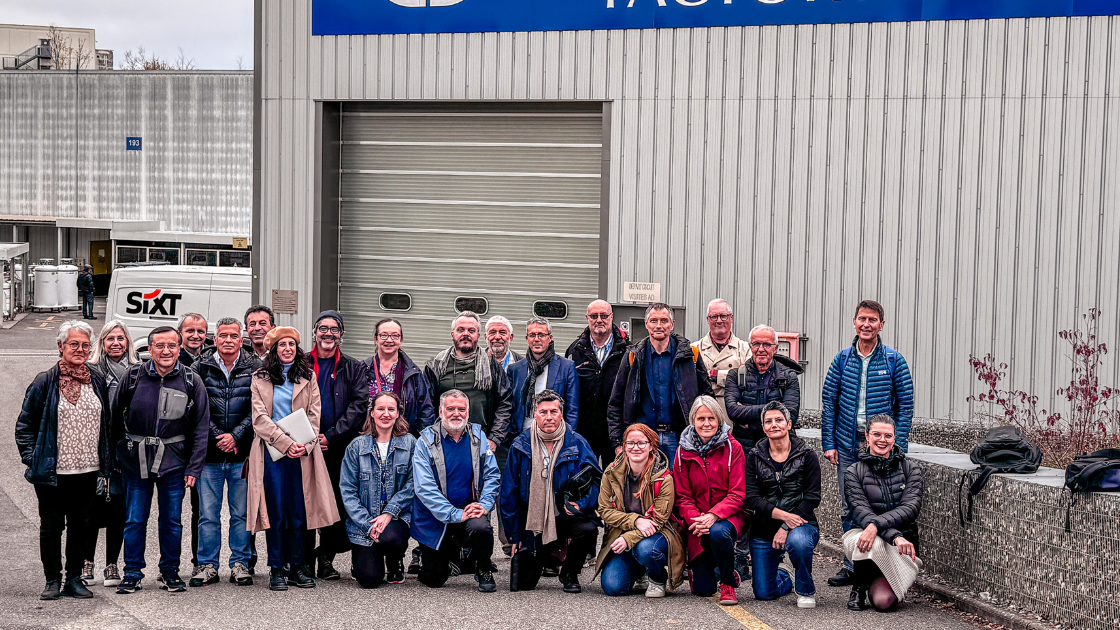
The afternoon started with a panorama of the current FCC project outreach landscape by Mathew Chalmers and Claire Adam-Bourdarios, followed by a visit to CERN’s Antiproton Decelerator (AD) guided by Ina Carli, representative of ALPHA, IPPOG’s newest member experiment, and a group photo.
Day 4 – Reports and Reflections
The final day focused on updates and coordination among IPPOG’s core structures:
Kenneth Cecire and Uta Bilow: Report from IMC
Kazuo Tanaka: Report from Global Cosmic
Claire Adam: Report from Resources Portal
Fabiola Cacciatore: Communication Report
Despina Hatzifotiadou: SPC Report
Charles Timmermans and Katharina Müller: Code of Conduct
Alexander Sharmazanashvili: IPPOG-GTU Agreement
The Collaboration Board (CB) meeting in the afternoon, reserved for representatives and their proxies, concluded the event with two major announcements: Km3NeT and DUNE officially joined IPPOG as new members.
The 30th IPPOG Meeting was full of celebrations, creativity, and commitment to sharing outreach of particle physics with the world. With new members, fresh ideas, and ongoing global initiatives, IPPOG continues to strengthen its mission of connecting science and people.