
by IPPOG Communication
Outreacher of the Month: Meet Cari Cesarotti
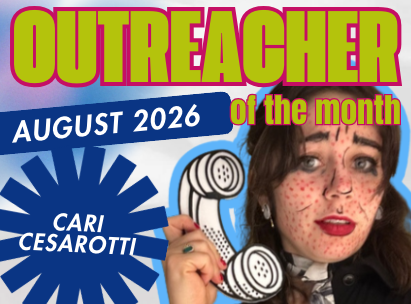
This month, IPPOG is delighted to feature Cari Cesarotti, a CERN Theory Fellow whose research focuses on one of the most exciting frontiers of particle physics: the search for new particles and forces, and the discovery potential of future particle colliders. Many members of the IPPOG Collaboration recently had the opportunity to hear Cari speak during our Collaboration Meeting in Slovenia, where she gave an engaging presentation about the fascinating world of muons. Her enthusiasm for both research and science communication made her a natural choice for this month's Outreacher of the Month. For Cari, science has always been more than just a subject to study. Growing up near Fermilab, she knew that becoming a physicist was a possibility, but it was the discovery of the Higgs boson during her final summer of high school that truly changed her perspective. We asked her a few questions about her journey into particle physics, her passion for muons, and what outreach means to her.
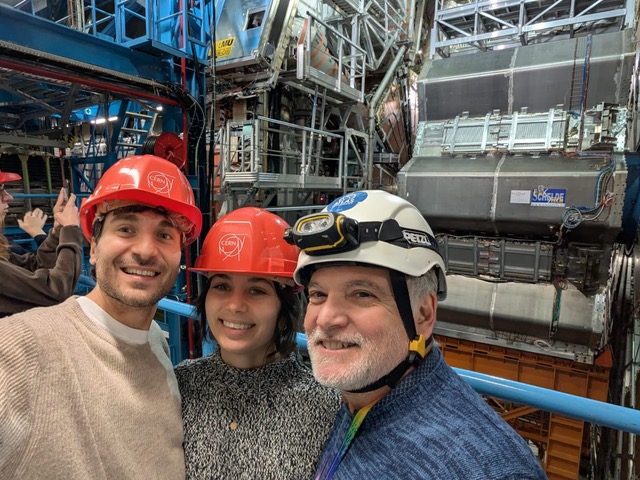
Could you briefly introduce yourself and tell us about your current role?
I'm Cari Cesarotti, a Fellow in the CERN Theory Department. I work primarily on searching for new particles and forces at our current collider, as well as predicting what possibilities for discovery we might have at future colliders.
What first inspired you to pursue a career in particle physics?
Science and math were always my favorite subjects when I was a young student. I grew up near Fermilab, so I knew that being a physicist was a possible career, but I had no idea what it really meant to be a researcher. Up until I applied to college, I thought I would become an engineer because it seemed like the best way to use the physics and math I loved.
During the last summer before I started college, the Higgs boson was discovered. I was amazed that not only were there still aspects of physics we didn't yet understand, but that we actually had the tools to make new discoveries. That's when science went from something you studied to something alive, and I knew I wanted to become a researcher.
At the recent IPPOG Collaboration Meeting in Slovenia, you gave an engaging talk about the muon. What makes the muon such a fascinating particle for you?
The muon is really a gateway particle to innovation in particle physics. It has many features that are well understood, like the properties it shares with the electron and its standard decays, but the fact that it decays means that our entire muon experimental program is completely novel. It sits right on the boundary between being a particle we can study with well-established techniques and being too short-lived to fully control. That's exactly what makes it so exciting.
What is the biggest challenge when explaining particle physics to non-experts, and what strategies have you found most effective?
Theoretical physics is a lot of math. We forget how much training we’ve had to be able to do calculus in our head or make reasonable estimations of difficult calculations. It’s definitely hard to try and restore some of that intuition without using math in a way that doesn’t become overly technical or a little bit wrong. I find the best way to get around this is doing one or two simple examples with a lot of patience. Your audience feels a pretty big reward when they can understand something nontrivial. Once you’ve established the simpler scenario, a less-straightforward result doesn’t seem as far away.
Have you had a particularly memorable outreach experience—perhaps a question from a student or member of the public—that has stayed with you?
Two years ago I was invited on a podcast to talk about muon colliders. It was a pretty famous one, so already being asking to talk about my research passion project to such a wide audience was exciting. The conversation we had was great since the host (Sean Carroll) has so much practice in asking questions in a way that brings a non-expert audience up to speed quickly. When the episode came out, it was really satisfying to share with my friends and family that otherwise don’t know what my research is, as well as to have people I’d known from high school or beyond reach out to me after years to say they heard the episode. It felt like I was bringing this niche experiment much more into the stage of pop culture.
Outside of physics, what hobbies or interests help you relax and recharge?
I love making things! I am always tinkering with something, like hacking my IKEA furniture, fixing espresso machines, or 3d printing my own designs. It’s really fun to have an outlet that is so opposite of theoretical physics; no mathematical modeling necessary, the only thing that matters is if the object serves the purpose you need!