
by IPPOG Communication
Outreacher of the Month: Meet Connie Potter
This month, IPPOG is delighted to feature Connie Potter, a long-standing member of CERN and the ATLAS Collaboration whose passion for science communication has helped redefine where and how people can experience particle physics.
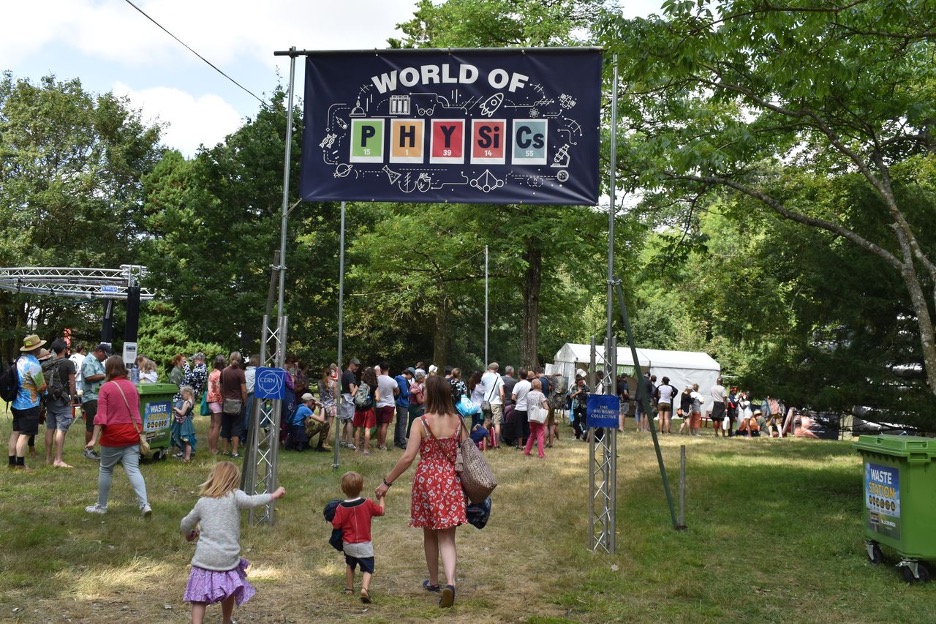
Many know Connie for her pioneering work on the CERN Festival Programme, which brings physics out of laboratories and lecture halls and into music and cultural festivals, reaching audiences who might never have imagined themselves engaging with science. What started as an experimental idea has grown into an international initiative, celebrating its tenth anniversary this year and inspiring similar programmes around the world.
In this interview, Connie reflects on the origins of the CERN Festival Programme, shares some of her most memorable outreach experiences, from muddy festival fields to Willie Nelson's ranch in Texas, and explains why successful science communication begins by seeing the world through your audience's eyes. She also offers valuable advice for anyone looking to engage new audiences and reveals one ambitious idea she would still love to see become a reality.
Enjoy the interview!
Could you briefly introduce yourself and tell us about your role at CERN?
I’m Connie Potter, long-standing member of CERN and of the ATLAS collaboration. In my many years here I’ve worked with many departments, from Finance to HR to the DG assistant role to the best role ever here in the ATLAS collaboration. In ATLAS I take care of their workshops, conferences, user contracts etc. And in whatever time I have left over I do communication and outreach.
You pioneered the idea of bringing particle physics to music and cultural festivals. Where did this idea come from, and did you ever imagine it would become so successful?
I can’t take credit for the original idea. It was Peter Gabriel’s close collaborator Mike Large, director of Peter’s festival entity WOMAD, who came for a CERN visit and at the end of the day said ‘you have to bring this to our music festival - our audience will love it!’. I initially said no, believing why would anybody in a beautiful festival, with the chance to listen to music, try cooking, dancing, having massages and listening to writers and comedians, want to go to hear about physics and science? I was eventually convinced by my co-founders Chris Thomas and Roger Jones, thinking ‘well if the Festival director thinks his audience would like it then he must know his audience – you’ve got to try once’. And he was right. That first year, 2016, we welcomed 4000 people over the 3 days to the Physics stage. The feedback was incredible. I couldn’t have imagined it would continue year after year, growing to what it is today. But almost every time I spoke about the programme at a conference, I’d have a physicist come up to me and say ‘this is amazing, can we try this at xx festival in our country’.mAlready if you’ve got that enthusiastic request from a physicist outreacher, you’re starting from a good place. Because it takes dedication and a lot of work to bring to fruition. The CERN Festival Programme is celebrating its 10 year anniversary this year. Since two years the programme is supported financially from the CERN and Society Foundation, and collaborates with teams and institutes and universities in eight different countries!
What has been one of your most memorable experiences engaging with people at festivals or other unconventional outreach events?
When Willie Nelson’s family asked me to produce a science stage on his ranch in Texas for his music festival, Luck Reunion, I was nervous. Such an unknown entity – an American country music audience.But again, we said, lets give it a try. And that is one of the most memorable recent experiences I have to say. The enthusiasm that the LUCK crowd showed for science.

Check it out https://www.instagram.com/reel/DY4dvGAy-bR/
Logistically, we are faced with all kinds of challenges when we go to festivals – as much as we prepare in advance with months of regular meetings, you never know what to expect or what could go wrong. Electricity not connected, accommodation not booked (imagine wandering around a wild campsite of festival goers at 3 am still looking for ‘your’ container for the night), a speaker accident at the last minute so the challenge of finding a replacement immediately. I am fortunate in that I have great, experienced, unflappable people working with me, including Phill Fox and Kaj Siebert as co-producers, who are fazed by nothing and quick to find solutions to any problem, any time of night or day.
But I guess one of the most ‘memorable’ experiences was at our first outing with the legendary Roskilde festival in Denmark: our space was ready, it was a very hot day, and our first visitor came in.
You have to be prepared for everything!
Your work has shown that outreach can happen far beyond classrooms and lecture halls. What advice would you give to scientists and communicators looking for creative ways to engage new audiences?
Limit your use of posters and ‘models’ and parts of detectors!
This is not an audience at an outreach session at a conference or a science festival.
You are talking to the lady at the till at the supermarket, the guy sweeping the street.
Put yourself in their shoes for a minute and think how to engage them more than trying to convince them about what you do.
The other thing I’d suggest is to get involved in as wide a variety of outreach activities as possible in order to expand your mind to other ideas, hear about other outreachers successes… and failures. Use your imagination – an idea presented, for example, at an IPPOG meeting, might just work in a different setting if you adapt it. I’ve found a couple of great speakers and interesting workshop ideas from IPPOG meetings these past years.
Looking ahead, is there an outreach idea or dream project that you would still love to make happen?
I’m regularly asked why I don’t produce a public CERN music festival. (The CERN music club produces the Hardronic Festival every year but that is limited to a CERN affiliated audience of about 1000 people). We’ve welcomed so many great artists for CERN visits over the years – from Muse to Metallica, from Jack White to Patti Smith to the Queens of the Stone Age. Who knows, maybe one of them might even be interested. Having a public music festival at CERN with even one of these headline acts would be challenging and such a decision is not mine to make.
Its not a dream – I don’t believe in dreams – to call something such just makes it seem unattainable.
But as an idea, I think its pretty cool.