by IPPOG Communication
Outreacher of the Month: Meet Gediminas Sarpis
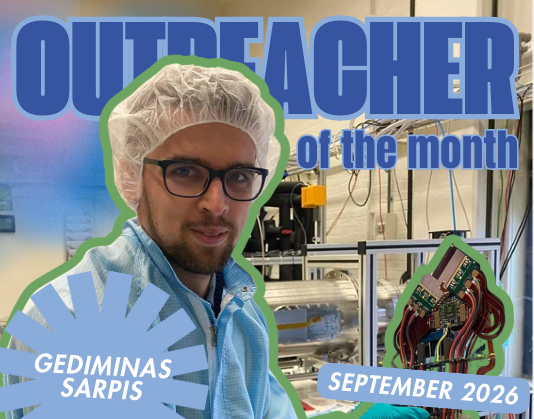
This month, IPPOG is delighted to feature Gediminas Sarpis, a CERN Research Fellow working within the LHCb collaboration. His research focuses on CP violation in charm, but his work extends well beyond the laboratory: from 2022 to 2025, he served as the LHCb Outreach Convener and has been involved in numerous science communication projects. Among these experiences, one stands out for its unusual setting and the questions it raised about who gets access to science: Physics Behind Bars, an outreach initiative bringing particle physics into prisons. For this specific project he has been featured as an Inspirational Success Story during the 31st IPPOG meeting in Slovenia.
In his work with inmates, Gediminas encountered audiences with a strong interest in and-understanding of-modern physics. Questions about special relativity, quantum mechanics, the Heisenberg uncertainty principle and the Pauli exclusion principle led to conversations that challenged some common assumptions about who engages with advanced science. The experience also offered unexpected moments. From a discussion about the tension in measurements of the age of the Universe suggested by JWST observations, to a much less conventional first seminar in which a participant asked to leave because he considered the material "nonsense", Gediminas' experiences highlight both the rewards and the challenges of reaching audiences outside traditional educational and scientific environments.
For Gediminas, outreach is not simply about communicating physics. It is also about sharing the values behind scientific research: curiosity, rational thinking, collaboration and trust in scientific methods. He sees this as a responsibility for researchers working in publicly funded, international and collaborative environments, and as an opportunity to contribute to a more informed and better-functioning society.
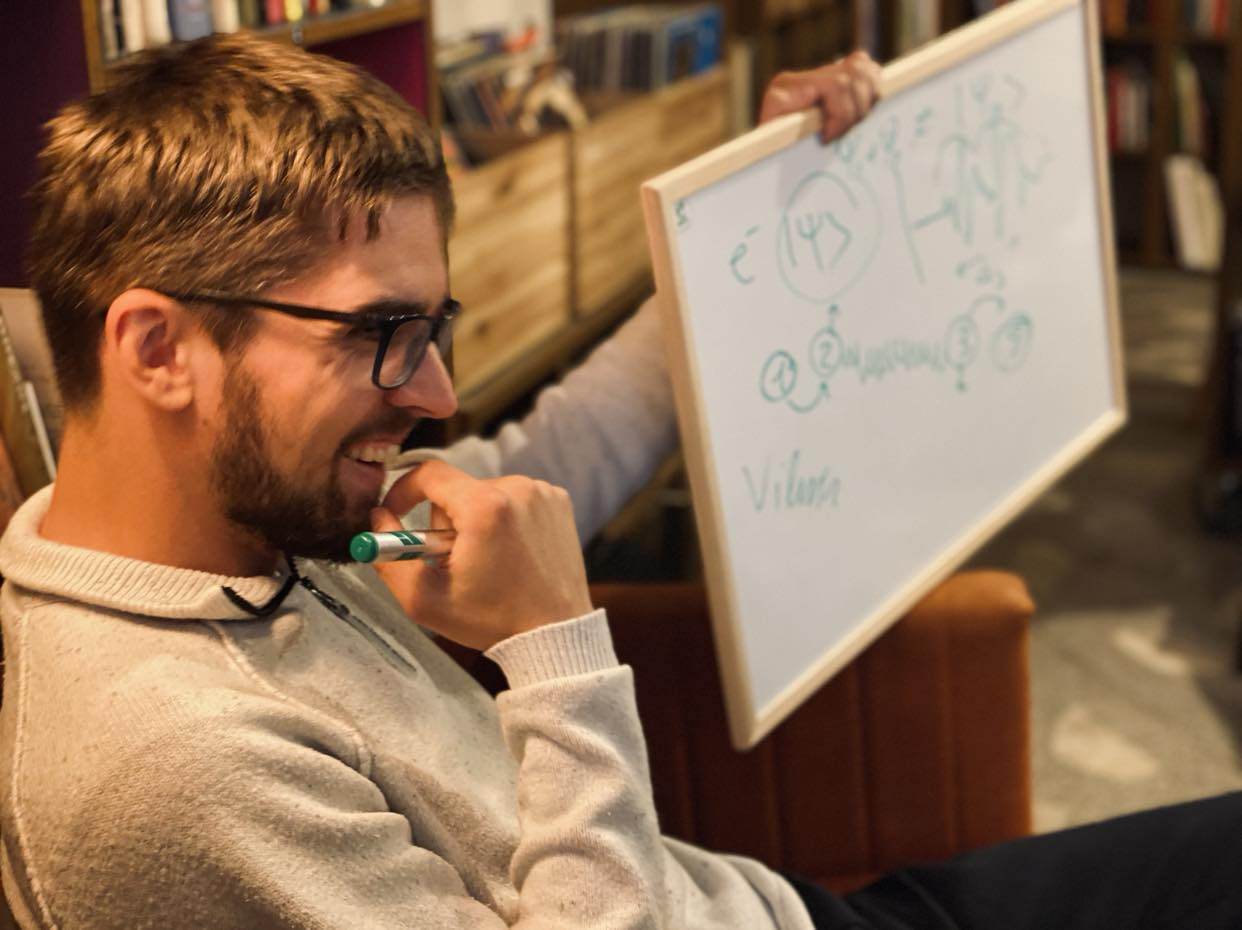
We asked Gediminas about his experience with Physics Behind Bars, the unexpected questions he encountered, and why reaching underrepresented audiences matters.
Could you briefly introduce yourself and tell us about your current role?
I am a CERN Research Fellow working within the LHCb collaboration. My current physics interests focus on CPV in charm. I served as the LHCb Outreach Convener from 2022 to 2025 and have been involved in numerous outreach projects.
What did you discover about your audience while bringing particle physics into prisons, and what challenges did you encounter?
The inmates I interacted with were all adults, generally older than me. They demonstrated a solid grasp of modern physics and asked insightful questions about special relativity, quantum mechanics, the Heisenberg uncertainty principle, and the Pauli exclusion principle. I was struck by how pervasive these complex ideas are, even among underrepresented groups that are often stereotyped as lacking access to quality education. One of the main challenges of outreach is to explain complex concepts in a coherent way that matches the audience’s level of understanding. My work in prisons exemplified this challenge and proved to be a particularly engaging and rewarding experience.
Was there a particular moment from your outreach work in prisons that stayed with you?
A particularly memorable moment occurred after one of my seminars, when an inmate approached me and mentioned that his former cellmate, now released, had been a physicist. They used to discuss physics frequently, especially astrophysics. I was then asked about the recent tension in measurements of the age of the Universe suggested by JWST observations. I was genuinely surprised by how current and advanced the knowledge was in such an unexpected setting. I also felt humbled and explained that astrophysics is not my area of expertise. This led to an interesting discussion about “known unknowns,” “unknown unknowns,” and even categorically unknowable questions.
Not all experiences were smooth. During my first seminar for inmates, delivered via Zoom, one participant stood up and shouted that he could not listen to this “nonsense” and asked to be taken back to his cell. This triggered a protocol requiring the session to stop while guards escorted him out. It was an unusual situation, one we do not encounter at scientific conferences, but it highlighted an important point: complex scientific material can be frustrating or disengaging for some audiences. As communicators, we need to remain attentive to this and avoid forcing engagement when it is not there.
Why do you think it is important for particle physicists to engage with society and reach audiences that may be underrepresented in science?
As mentioned elsewhere, I believe that fostering a positive outlook toward a rational, scientific worldview and sharing modern scientific knowledge is inherently beneficial to society. The connections extend beyond physics: trust in scientific methods developed in fields like high-energy physics can translate into trust in medicine, improved financial literacy, and even better collaboration and interdisciplinary skills. I believe that high-energy physicists are in a privileged position, benefiting from publicly funded, international, and highly collaborative research environments. This creates a responsibility to give back and to serve as an example of a part of society that functions effectively.
This responsibility implies engaging with society at all levels: inspiring curiosity in younger students, recruiting high school and undergraduate students into science, and communicating with non-experts and underrepresented groups. In doing so, we help ensure that science is viewed positively, which, in my view, contributes to a more informed and better-functioning society overall.